

Introduction: The Power of the Sunday-Night Switch
The modern pace of life demands more than just a hasty to-do list scribbled on the back of a receipt. If you frequently feel like you’re battling Monday morning chaos, constantly putting out fires, and collapsing into Friday exhausted with little to show for your effort, the problem isn’t your commitment it’s your method.
Planning your week should not feel like another chore; it should be a deliberate, restorative act of self-care. It’s the ritual that transforms stress into structure, and busyness into purpose.
In this ultimate guide, we are moving beyond the to-do list to embrace a holistic planning approach. We’ve compiled 105+ Weekly Planning Tips and Blessings designed to help you not just manage your time, but to master your life. We will combine practical, tactical strategies with mindful, intentional blessings to ensure your week is productive, peaceful, and powered by purpose.
Quick Answer Box: What is the best weekly planning method?
The best weekly planning method is the Holistic Planning Approach, which combines tactical time management (time blocking, task batching) with intentional living (scheduling rest and self-care). It requires setting 1-3 “Big Rocks” (MITs) for the week and performing a structured planning session (30-60 minutes) at the week’s close, reviewing past performance and setting clear intentions for the next.
This guide is structured into three powerful sections:
- The Pre-Planning Ritual: Getting your environment, mind, and data ready.
- Actionable Planning Strategies: Tactical ways to use your time and tools.
- The Mindful ‘Blessings’: Intentional living, self-care, and mindset shifts.
Let’s dive into the ultimate plan for your most successful week yet.
The Pre-Planning Ritual (Tips 1-35)
The effectiveness of your week hinges entirely on the preparation you do beforehand. This is the crucial, sacred time where you transition from reactive mode to proactive mode.
Setting the Stage: Environment & Tools (Tips 1-10)
Before you touch a pen or a screen, create the ideal conditions for focus and clarity.
- Clear the Deck: The first tip is always environmental. Clear your physical planning space (desk, kitchen table). A clear space equals a clear mind.
- Gather All Inputs: Collect every source of information: email inbox, calendar, loose notes, sticky notes, and voice memos.
- Choose One Master Tool: Designate a single source of truth whether it’s a digital app (Notion, Google Calendar) or a physical planner. Avoid splitting your plan across four different systems.
- Set the Mood: Light a candle, play calming instrumental music, or make a cup of tea. Planning should feel like a luxurious ritual, not a rushed task.
- Charge Your Devices: If using digital tools, ensure your laptop, tablet, or phone is fully charged so technical glitches don’t break your flow.
- Use the Right Pen/Color Coding: Studies show that engaging fine motor skills (like choosing a pen or color) helps solidify plans. Assign specific colors (e.g., Green for Wellness, Blue for Work).
- Disable Notifications: Put your phone on airplane mode or use a “focus mode” to ensure your 30-60 minutes of planning are uninterrupted.
- Block the Time: Schedule the planning session itself into your calendar (e.g., Sunday 7:00 PM). If it’s not scheduled, it won’t happen.
- Date Your Plan: Even if using digital, mentally or physically mark the week you are planning (e.g., “Week of December 15th”).
- Hydrate First: Ensure your brain is primed by drinking a large glass of water before you begin the deep thinking involved in planning.

The Weekly Brain Dump and Review (Tips 11-25)
Before looking forward, you must effectively process the past and clear your mind of clutter. This is the Brain Dump phase.
- Review Last Week’s Wins: What 3 things did you succeed at? Celebrate them, no matter how small. This builds momentum.
- Analyze Last Week’s Losses: What 1-2 things fell apart? Crucially, don’t judge it. Just analyze why (e.g., lack of time, lack of clarity, distraction).
- Migrate Unfinished Tasks: Move any truly necessary tasks from last week into the new week’s to-do list. Be ruthless: if a task is migrating for the third week, delete it or assign a dedicated time block.
- Conduct a Mental Mind Sweep: Write down everything that is currently floating in your head: that overdue dental appointment, the idea for a new project, the grocery list item.1
- The 2-Minute Rule (GTD): If any item on your dump list can be done in under two minutes, do it now and cross it off immediately.
- Toss the Trash: Physically or digitally delete notes, tasks, or papers that are no longer relevant, saving only what needs action.
- Identify Pending Communications: Scroll through texts/emails and list anyone you owe a response to, especially personal connections.
- Check Financials Briefly: Dedicate 5 minutes to review your budget or bank account. A financial check provides a clear picture of resources.
- Schedule Routine Maintenance: Plan weekly activities that keep your life running (laundry, meal prep, paying bills). These are “non-negotiables.”
- Assign Context: Next to each dumped item, note the context: @Home, @Office, @Errand. This makes batching possible later.
- The Three R’s (Reduce, Refine, Relegate): If the list is still too long: Reduce the scope, Refine the task into a single, doable step, or Relegate it to the “Maybe Later” list.
- Break Down Big Projects: If a dumped item is a large project (e.g., “Plan vacation”), break it into 3 smaller, actionable sub-tasks (e.g., “Research flight costs”).
- Clear Your Inbox: Ensure you have zero pending decisions in your email. Either delete, delegate, or turn the email into a task on your plan.
- Confirm Commitments: Check your calendar for all pre-booked appointments (meetings, doctor, kids’ events) and ensure they are accurately transferred to your weekly plan.
- Final Cleanse: Take a deep breath. Tell yourself: “My mind is now empty and ready to receive clear instructions.”
The Power of Three: Weekly Goal Setting (Tips 26-35)
Effective planning starts with intentionality, not task management. Focus on results, not just effort.
- Identify Your Big Rocks (MITs): Name the 3 Most Important Tasks (MITs) that must be completed this week to feel successful.
- Differentiate Outcome vs. Action: Your goals should be actionable. Instead of “Improve SEO,” use “Write the SEO article brief and outline.”
- Link to Larger Vision: Ask: “Which of these 3 MITs helps me reach my month-end or quarter-end goals?”
- Protect the MITs: Once your Big Rocks are identified, the rest of your schedule must be built around them, not vice-versa.
- Set One Personal Goal: Your three MITs shouldn’t be all work. Include one personal growth or health goal (e.g., “Walk 10,000 steps three times”).
- Determine the Success Metric: How will you know if your MIT was successful? Define the outcome clearly before the week begins.
- Use the Reverse Engineering Trick: Start planning Friday afternoon’s status, and work backward to Monday morning.
- Pre-Write the First Task: Always conclude this phase by writing down the absolute first task you will do when you start on Monday morning.
- Plan Your Friday Buffer: Intentionally leave 2-4 hours of unstructured time on Friday for unexpected tasks or to complete spillover work.
- The 90-Minute Rule: When planning deep work, schedule it in 90-minute focused blocks. This honors the natural human energy cycle.
Actionable Planning Strategies (Tips 36-70)
This is where the rubber meets the road. These tips focus on the tactical execution of time management using your Big Rocks and task list.
Mastering Time Blocking vs. The To-Do List (Tips 36-47)
A to-do list is a wish list; a time-blocked calendar is a commitment. Effective planners utilize both.
- Block Deep Work First: Immediately schedule time blocks for your Big Rocks (MITs) before any meetings or minor tasks.
- Color-Code Your Blocks: Use color coding to quickly see where your time is going (e.g., Red = Client Work, Yellow = Personal/Self-Care, Grey = Admin/Email).
- Schedule All Transitions: Block 10 minutes between meetings or tasks. This prevents scheduling delays from spilling over.
- The Time Budget: Ask yourself, “How much time am I willing to spend on this task?” and block only that amount.
- Use Time Boxes for Admin: Set a specific, hard limit (e.g., 30 minutes) for dreaded tasks like emails and financial reports.
- Block ‘White Space’: Intentionally leave blocks with nothing scheduled. This is your breathing room, for unexpected events, creative thinking, or rest.
- Convert the To-Do List: Every task on your list must be converted into a scheduled time block or a scheduled day for batching.
- Apply the Eisenhower Matrix: Use this simple prioritization framework to allocate time.
| Urgency / Importance | High Importance | Low Importance |
| High Urgency | DO (Immediate Action) | DELEGATE (or Automate) |
| Low Urgency | DECIDE (Schedule for Later) | DELETE (or Reduce Scope) |
- Plan for Energy Levels: Schedule your most challenging tasks during your peak energy hours (e.g., 8 AM – 12 PM). Schedule admin for afternoon dips.
- Review the Flow: Step back and look at your entire week. Does the flow look sustainable? Are there days that look overwhelmingly dense? Adjust now.
- Use Digital Drag-and-Drop: If using a digital calendar, don’t delete missed blocks drag them to the next available block immediately.
- The Sunday Calendar Check: Before wrapping up your planning session, check the week for scheduling conflicts one last time.

The Daily Micro-Plan (Morning & Evening) (Tips 48-57)
Effective weekly planning requires micro-adjustments daily.
- Plan Tomorrow Tonight: Every evening, dedicate 5 minutes to review tomorrow’s schedule and select the 3 most crucial tasks.
- Prep the Night Before: Lay out your clothes, pack your lunch, and prep your coffee maker. Eliminate decisions for the morning.
- The “Eat the Frog” Method: Schedule your single worst/hardest task (your “Frog”) as the very first thing you do when you start work.
- Morning Ritual Protection: Block your non-negotiable morning routine (meditation, exercise, quiet time) as sacred calendar blocks.
- Review End-of-Day: Before logging off, check what you accomplished against your 3 daily goals. This provides satisfying closure.
- Clear Your Desk for the Night: Ensure your workspace is clean, ready for a fresh start the next morning.
- Don’t Check Email in Bed: Resist the urge to check the next day’s schedule or email after the evening wind-down begins.
- Set an Out-of-Office: If you are planning an intense Deep Work session, use a quick auto-reply stating you’ll respond at a specific time.
- Pre-load Resources: If a task requires a specific file or link, open it and leave the window ready on your desktop for the next day.
- Write an Affirmation: Write a quick, positive affirmation for the next day (e.g., “I will be focused and productive tomorrow”) on a sticky note.
Batching and Efficiency Hacks (Tips 58-70)
Batching similar tasks saves enormous amounts of mental energy (context switching).
- Theme Your Days (Themed Planning): Assign a purpose to each day to minimize context switching.
| Day | Suggested Theme | Examples |
| Monday | Strategy & Deep Work | Goal setting, writing major reports, project kickoff. |
| Tuesday | Meetings & Collaboration | Client calls, internal syncs, team feedback. |
| Wednesday | Creation & Content | Writing, design work, video editing, recording. |
| Thursday | Sales & Networking | Prospecting, follow-ups, informational interviews. |
| Friday | Admin & Review | Inbox zero, expense reports, billing, weekly review. |
- Batch All Communication: Only check email, Slack, and texts at three designated times during the day (e.g., 10 AM, 1 PM, 4 PM).
- Errand Batching: When planning errands, group all tasks based on location (e.g., Post office, grocery store, bank all in one trip).
- Meal Prep Batching: Dedicate 2-3 hours on Sunday/Monday to prep meals and snacks for the entire week to save daily decision-making.
- Use the 5-Minute Rule for Quick Hits: If an interruption or new task takes less than 5 minutes, do it immediately to prevent it from cluttering the list.
- Set Sprint Timers: Use the Pomodoro Technique (25 minutes of work, 5 minutes of rest) for focused tasks to maintain energy.
- Delegate When Possible: If a task doesn’t require your specific skill set, delegate it, and block time for the delegation process itself.
- Automate the Mundane: Use tools (IFTTT, Zapier) to automate repetitive data entry, email filtering, or social media scheduling.
- Plan for Interruptions: Assume 10-15% of your focused time will be lost to unplanned events and schedule buffer time accordingly.
- Create Standard Operating Procedures (SOPs): Write down the steps for repetitive tasks (e.g., weekly social media report) so you don’t have to rethink the process.
- Practice Inbox Zero: Not just clearing emails, but processing them into four categories: Delete, Delegate, Defer (schedule time to action), or Do (use the 2-Minute rule).
- Always Plan Your Breaks: Breaks are not earned; they are scheduled. A well-planned break improves focus when you return.
- The One-Touch Rule: When processing mail, papers, or email, try to only “touch” the item once. Process it, file it, or act on it immediately.
The Mindful ‘Blessings’ (Tips 71-105+)
This section integrates the intentional, mindful approach that turns planning into a sustainable, joy-filled practice. The “blessings” are powerful mindset shifts.
Planning for Self-Care & Energy Management (Tips 71-85)
You cannot pour from an empty cup. Schedule your rest as seriously as you schedule your work.
- Schedule Mandatory Breaks: Block 15-30 minutes for lunch away from your desk. Call it “Essential Refuel Time.”
- Plan Your Joy First: What brings you genuine joy? Schedule it (e.g., reading, gardening, playing a game). Treat it as a non-negotiable MIT.
- Block Movement: Schedule workouts, walks, or simple stretching breaks throughout the day.
- Set a Daily Hard Stop: Decide when you will stop working each day (e.g., 5:30 PM) and honor that boundary.
- Digital Sabbath: Plan at least a few hours (or a full day) where you intentionally avoid all work-related screens.
- Schedule Connection Time: Block time for quality connection with loved ones, free from phone distractions.
- Track Your Sleep: Use a planner column or tracker to monitor sleep. Use that data to adjust your work blocks if your energy is low.
- Plan for Fuel: Pre-plan your healthy snacks and meals so decision fatigue doesn’t lead to poor choices.
- Integrate Micro-Meditations: Schedule 3 minutes of breathing or mindful silence between major tasks.
- Plan for Your ‘Commute’: If you work remotely, plan a physical boundary (e.g., a walk around the block) to transition into “work mode” and “home mode.”
- Blessing for Self-Care: Acknowledge your capacity is finite; rest is not a reward, it is a necessity that fuels sustainable effort.
- The “Plan B” Block: If you feel an energy dip, have a pre-planned, easy, low-focus task ready to pivot to (e.g., filing, organizing files).
- Review Your Wellness Inputs: Use the planning session to schedule refills on prescriptions, vitamins, or therapy sessions.
- Set Intentions for Sleep: Write down what you hope to dream about or an intention for restorative sleep.
- Blessing for Boundaries: May you find the strength to honor the lines you have drawn, protecting your peace from the urgency of others.
The Planner’s Mindset: Intentional Living (Tips 86-95)
Planning is a tool for intention. Use your week to reflect your values.
- Identify the Feeling: When you look at your schedule, how do you want to feel (e.g., calm, focused, accomplished)? Plan activities that generate that feeling.
- Plan Your ‘No’s’: Planning is deciding what not to do. List tasks or requests you will actively decline this week.
- Practice a Weekly Gratitude Review: Write down 5 things you are deeply thankful for before starting the plan. This sets a positive tone.
- Define Your Personal Mantra: Choose a single word or phrase for the week (e.g., Presence, Focus, Action) and write it at the top of your planner.
- The Weekly Visioning: Spend 2 minutes visualizing your perfect week unfolding smoothly.
- Blessing for Focus: May your attention be your greatest asset this week, directed only toward what truly matters and aligned with your deepest values.
- Practice the “Pivot, Not Fail” Mentality: If you miss a task or a block, don’t spiral. Immediately adjust the next block and forgive the past moment.
- Plan for Flexibility: Avoid booking yourself at 100% capacity. An 80% full schedule is a success.
- Check Your Internal Dialogue: Throughout the planning, replace phrases like “I have to” with “I choose to” or “I get to.”
- Blessing for Abundance: May this week bring more than just productivity may it bring opportunities for growth, learning, and unexpected joy.
Overcoming Overwhelm and Sticking to the Plan (Tips 96-105+)
The best plan is the one you actually follow.
- The Review/Tweak Session: Schedule a 10-minute mid-week check-in (e.g., Wednesday lunch) to adjust blocks and re-prioritize.
- If You Get Stuck, Change Location: If a planned work session isn’t going well, physically move (to a chair, coffee shop, or another room).
- Use Transition Music: Assign a specific 5-minute song to play before starting a new work block. It signals your brain to focus.
- Re-Read Your ‘Why’: When motivation lags, reread your 3 Big Rocks and your weekly mantra. Remind yourself why you planned this task.
- Schedule Rewards: Plan small rewards immediately after completing your Big Rocks (e.g., a nice coffee, 15 minutes of guilt-free scrolling).
- Blessing for Resilience: May you be gentle with your imperfections and fierce with your focus, returning to your intention with every fresh moment.
- Create a “Not-To-Do” List: Explicitly list 3 things you are forbidden from doing this week (e.g., checking social media before noon, taking work calls after 6 PM).
- Identify the Barrier: When procrastinating, ask, “What is the single hardest step of this task?” and only schedule that one step.
- Batch Your Fun: Plan your social media or entertainment consumption. Don’t let it interrupt you randomly.
- Post-Planning Celebration: Once the plan is complete, do a physical, celebratory action (stretch, pump your fists, ring a bell). Anchor the feeling of accomplishment.
Quick Hits for Maximum Efficiency
- Use keyboard shortcuts religiously.
- Always save files with clear, searchable names.
- Invest in noise-canceling headphones.
- Block time to learn one new productivity shortcut each week.
- Time how long core tasks actually take to improve future planning accuracy.
- Keep a water bottle visible at all times.
- Clear browser tabs before starting Deep Work.
FAQS about weekly planning
What is the 7 8 9 rule for time management?
The 7 8 9 rule is a simple productivity guideline focused on daily scheduling:
- 7 hours of sleep (minimum).
- 8 hours of focused work (your professional commitment).
- 9 hours for life (personal time, self-care, family, meals, commuting, hobbies, etc.).
It promotes balance by ensuring necessary rest and personal time are accounted for alongside work.
How to effectively use a weekly planner?
To effectively use a weekly planner, adopt a Holistic Planning Ritual:
- Conduct a Weekly Review: Look back at the last week to assess wins and losses.
- Define Big Rocks (MITs): Identify 1-3 Most Important Tasks or goals for the coming week.
- Time Block: Schedule every commitment and action task (including breaks and self-care) into specific time slots, not just a list.
- Review Daily: Spend 5-10 minutes each evening reviewing and adjusting the next day’s schedule.
What’s the best layout for a weekly planner?
The best layout depends on your needs, but generally, a good weekly planner combines:
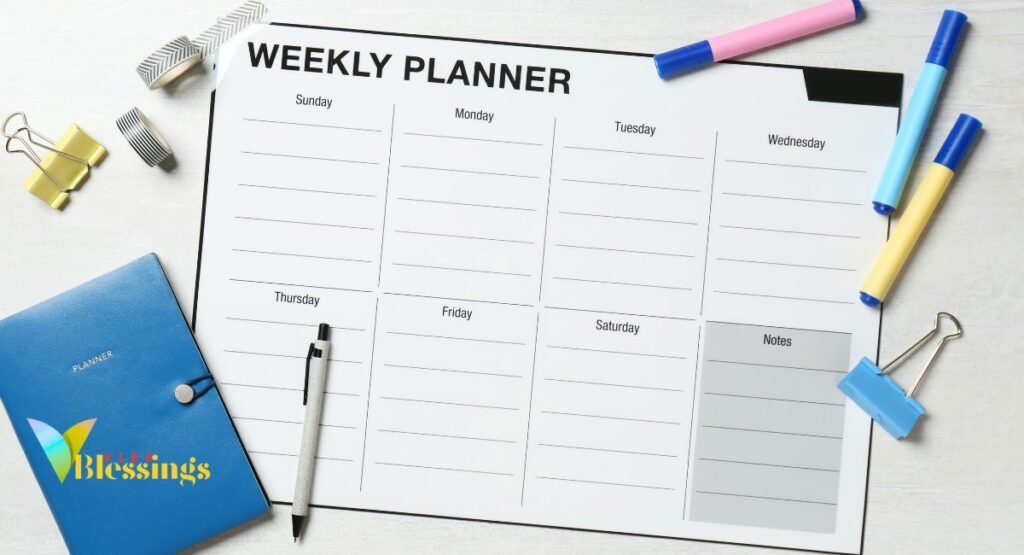
- Calendar View: A Vertical or Horizontal Column Layout (one column/section per day) to visualize appointments and time blocks.
- Task List: A dedicated area for Weekly Goals/MITs and a running To-Do List separate from the daily columns.
- Notes Section: Space for a Weekly Brain Dump, habit tracking, or a mantra/focus word.
What are the 7 steps of planning?
The specific models vary, but a common framework for the 7 steps of planning in time management and goal setting is:
- Goal Setting: Define the desired outcome.
- Information Gathering: Collect relevant data, resources, and pending tasks (Brain Dump).
- Analysis: Review the constraints, available time, and resources.
- Strategy Development: Create the action plan (Time Blocking and Prioritization).
- Implementation/Action: Execute the plan.
- Monitoring: Track progress daily and weekly.
- Review and Adjustment: Evaluate results and modify the plan for the future.
Final Takeaway and Next Steps
Weekly planning is less about being busy and more about being intentional. By blending tactical productivity tips with mindful blessings, you move from passively reacting to your schedule to actively designing your destiny. The goal is not perfection, but progress and peace.
Remember:
- Plan the Big Rocks First.
- Schedule Rest as a Necessity.
- Be Gentle, Be Focused, Be Intentional.

Hi, I’m Taimoor Abid, founder of Vibe Blessings! I specialize in creating SEO-optimized inspirational content.